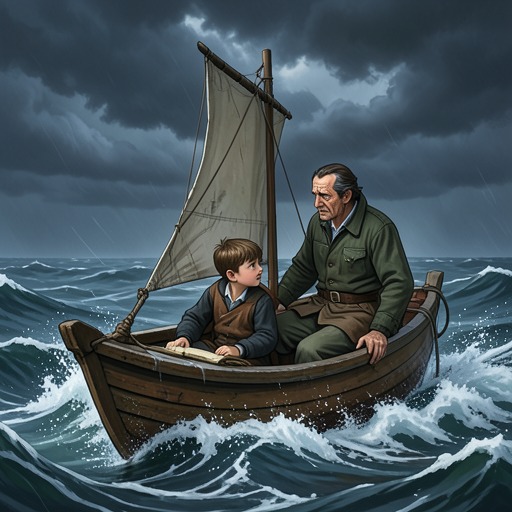
Pinocchio dives into the sea to save Geppetto
The Adventures of PinocchioPinocchio dives into the sea to save Geppetto after learning that his father has spent months searching for him and is now trying to cross the ocean in a tiny boat. The scene transforms a reunion hoped for at a distance into a rescue attempt in dangerous water: Pinocchio calls Geppetto his father, watches the boat disappear in a wave, and jumps in after him, disappearing from view himself.
Causes and Background
The crisis begins with Pinocchio alone and grieving. He believes the Fairy has died and does not know where Geppetto is; he fears being left without either of the people he loves. A large Pigeon encounters him in this state and asks what he is doing. When Pinocchio explains his distress, the bird asks whether he knows Geppetto. Pinocchio answers that Geppetto is his father and urgently asks whether he is alive and whether the Pigeon can take him to him.
The Pigeon supplies news that changes the scale of Pinocchio’s loss. It had left Geppetto three days earlier on the shore of a large sea. Geppetto was building a little boat to cross the ocean because, for four months, he had wandered around Europe looking for Pinocchio; having failed to find him, he had decided to search in the New World. Pinocchio’s absence is thus answered by evidence of sustained paternal effort. The father he thought lost has been looking for him, and is now risking another journey to continue the search.
The distance makes this disclosure more than a promise of reunion. The shore is more than fifty miles away. The Pigeon carries Pinocchio toward it; after a short rest, they set out again and arrive the following morning. Their travel narrows the gap between father and son, but the sea still separates them, and Geppetto’s small craft is already exposed to its danger.
The Shore and the Boat
When Pinocchio reaches the shore, he finds people gathered there, crying out and tearing their hair as they look toward the water. A little old woman explains the danger: a poor old father, whose only son had been lost to him, has built a tiny boat to search across the ocean. The water is very rough, and the onlookers fear that he will drown. The crowd’s description makes clear that they do not yet know the boat’s passenger as Pinocchio’s father.
The woman points toward a shadow on the sea, no bigger than a nutshell. Pinocchio watches closely, then recognizes Geppetto and cries out that it is his father. The boat appears and disappears among the waves. From a high rock, exhausted from searching, Pinocchio waves with his hand, his cap, and even his nose. The gesture is both a signal across the distance and a striking reminder of his wooden body: the nose that has marked his earlier misadventures becomes part of his attempt to reach his father.
Geppetto seems to recognize Pinocchio. He takes off his cap and waves back, apparently trying to show that he will return if he can. But the sea prevents him from controlling the boat with his oars. A huge wave rises, and the little boat disappears. The scene’s brief exchange of waves offers recognition without reunion: father and son see one another, yet the water leaves Geppetto unable to reach shore.
The Dive and Its Immediate Stakes
The fisher folk wait for the boat to reappear, but it is gone. They whisper a prayer for the old man and begin to turn away. At that point, Pinocchio dives into the sea, crying that he will save his father. His response is immediate; the disappearance of the boat does not persuade him to accept the crowd’s helplessness or the apparent end of the search.
His wooden body gives him a specific advantage in the water. He floats easily and swims like a fish through the rough sea, disappearing and reappearing as he moves farther from land. The same material nature that distinguishes him from an ordinary boy now serves the rescue attempt. Yet it does not make the attempt safe: he swims into the waves alone, and at last he vanishes completely from view. The onlookers, who had already prayed for Geppetto, now grieve for Pinocchio as well.
The scene ends on that disappearance rather than showing whether Pinocchio reaches the boat. Its immediate consequence is therefore a doubled uncertainty: the father’s boat has been lost from sight, and the son who plunged after him is gone from view too. Pinocchio’s declared intention is unmistakable, but the outcome of the rescue remains unresolved at this moment.
Reversal and Narrative Significance
The dive reverses the pattern of Pinocchio’s earlier conduct. On the road, he had dismissed the Talking Cricket’s advice and convinced himself that warnings were inventions meant to frighten children who ran away at night. Here, the remembered risk is no longer something he can reason away. He has learned that his father is seeking him, sees the boat swallowed by a wave, and acts before safety or success can be assured. The change is expressed through action rather than an explanation of his character: he turns toward danger for Geppetto.
The scene also redirects the story from Pinocchio’s fear of abandonment to the consequences of a bond sustained across absence. Geppetto has crossed Europe in search of his son and is preparing to cross the ocean; Pinocchio, upon finding him at a distance, enters the sea in turn. Their efforts mirror one another, but not in equal circumstances: Geppetto is trapped in a boat he cannot command against the waves, while Pinocchio can keep swimming because he floats. That advantage brings him toward his father, but the final image withholds the assurance of reunion. The rescue attempt is both a decisive act of filial concern and a threshold into greater danger.